If you’ve spent any time researching digital marketing for your business, you’ve encountered the debate: should you invest in organic SEO, paid search advertising, or both? The answer has real consequences for how quickly you get results, how much you spend, and how sustainable your lead flow is over time. Getting organic SEO vs. paid search explained clearly — without the jargon — is the starting point for making smart decisions about where your marketing dollars go. At Local Blitz, we’ve been managing both channels for small businesses in Indianapolis and San Diego since 2009, and the honest answer is that the right approach is almost always a combination of the two. Here’s how each one works, what each one costs, and how to decide which deserves more of your attention right now.
The Core Difference: Earned Visibility vs. Purchased Visibility
Contents
- 1 The Core Difference: Earned Visibility vs. Purchased Visibility
- 2 How Organic SEO Works and What It Actually Takes
- 3 How Paid Search Works and What It Actually Costs
- 4 Organic SEO vs. Paid Search: A Direct Comparison
- 5 When to Prioritize One Over the Other — and When to Run Both
- 6 A Note on “Organic SEO Is Free” — It Isn’t, Exactly
- 7 Frequently Asked Questions: Organic SEO vs. Paid Search
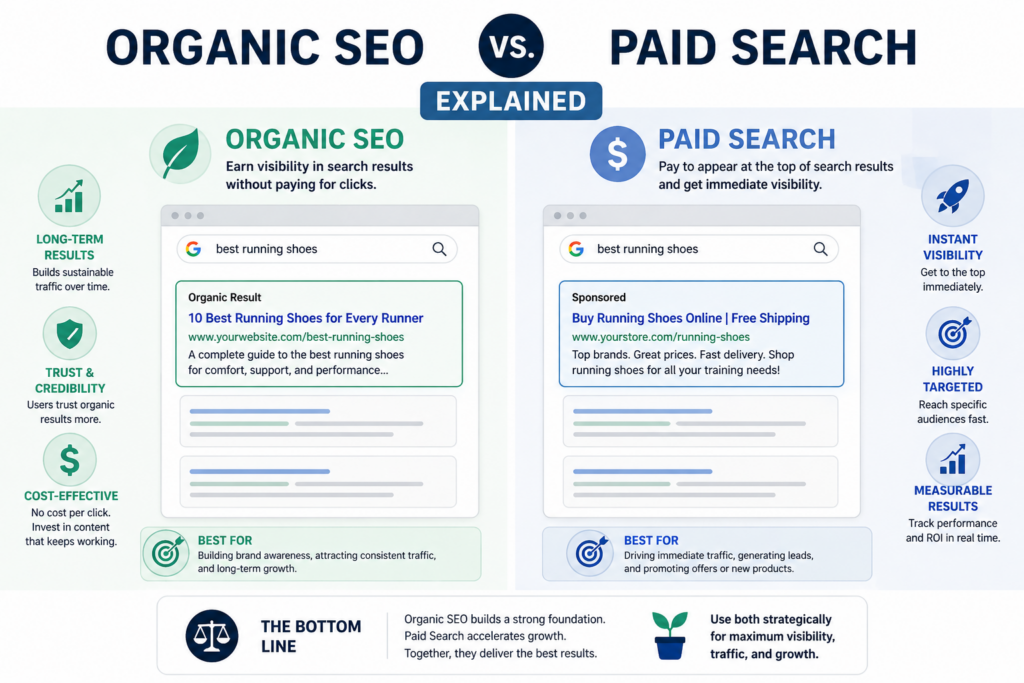
Organic SEO and paid search both put your business in front of people searching on Google and other search engines — but they get you there in fundamentally different ways.
Organic SEO is the practice of earning visibility in the non-paid, algorithmic section of search results. When Google determines that your website is the most relevant, authoritative, and trustworthy result for a given search query, it places your page in those results — for free, per click. You don’t pay Google when someone finds you organically. What you invest is the time, expertise, and resources required to build the kind of website, content, and online presence that Google’s algorithm rewards.
Paid search — most commonly through Google Ads, formerly called Google AdWords — is the practice of bidding for ad placement at the top of search results for specific keywords. When someone searches a term you’ve bid on, your ad appears above the organic results, marked with a small “Sponsored” label. You pay each time someone clicks your ad, which is why it’s also called pay-per-click (PPC) advertising. The moment you stop funding the campaign, your ads disappear from the results page.
Both channels target people who are actively searching for what you offer — which makes search one of the highest-intent marketing environments available. But the mechanics, costs, timelines, and long-term economics of organic versus paid are significantly different.
How Organic SEO Works and What It Actually Takes
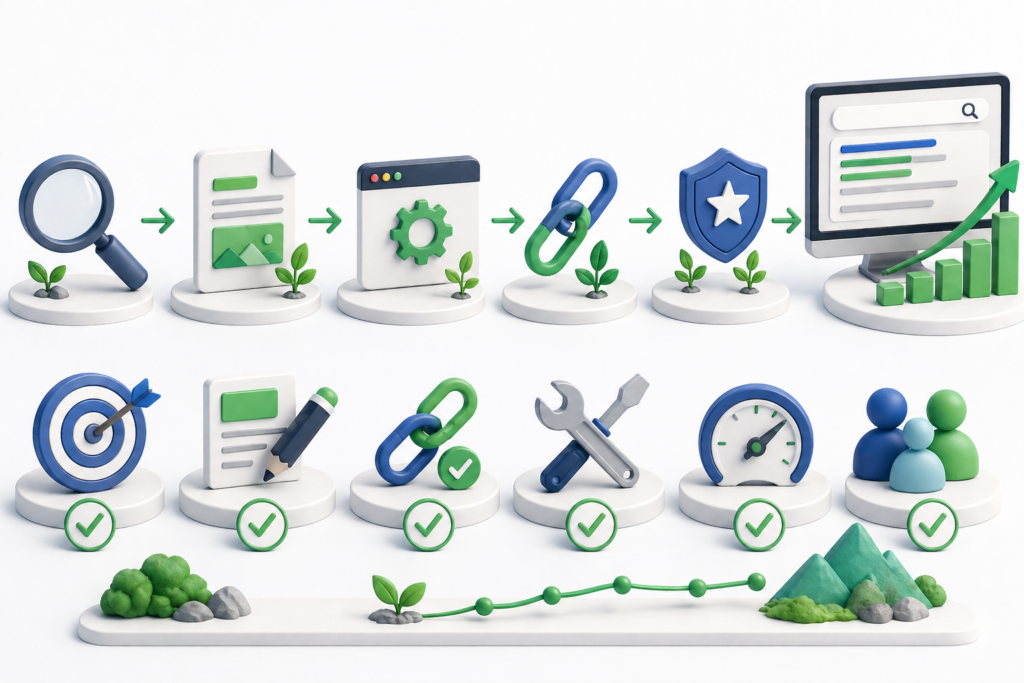
Organic rankings are determined by Google’s algorithm, which evaluates hundreds of signals to decide which pages best answer a given search query. The major factors that drive organic rankings include:
- Content quality and relevance — Does your page comprehensively address what the searcher is looking for? Is it well-written, accurate, and genuinely useful?
- Technical SEO — Is your site fast, mobile-friendly, secure (HTTPS), and properly structured so that Google can crawl and index it correctly?
- Backlinks and authority — Do other credible websites link to yours? External links from reputable sources signal to Google that your site is trustworthy.
- User experience signals — Do visitors stay on your pages and engage with your content, or do they quickly leave? Engagement signals help Google evaluate whether your content is actually satisfying searchers.
- Local SEO signals — For businesses serving a specific geographic area, your Google Business Profile, local citations, and location-relevant content all influence how you rank in local search results.
Building strong organic rankings takes time. Most SEO campaigns targeting competitive local keywords take three to six months to produce meaningful results, and twelve months or more to reach top positions in highly competitive markets. That’s the main trade-off with organic SEO: the investment comes before the return.
But the long-term economics are compelling. Once your pages earn strong rankings, they generate traffic and leads without a cost-per-click. According to BrightEdge research, organic search drives approximately 53% of all website traffic — making it the single largest source of online visits for most businesses. Content that ranks well can continue attracting customers for years after it was created, making SEO one of the few marketing investments that genuinely compounds over time.
How Paid Search Works and What It Actually Costs
Paid search through Google Ads operates on an auction system. You select the keywords you want your ads to appear for, set a maximum bid (the most you’re willing to pay per click), and create the ad copy that appears when those terms are searched. Google then determines your ad’s placement based on a combination of your bid and your Quality Score — a measure of how relevant and useful your ad and landing page are to the searcher.
The cost-per-click (CPC) for a given keyword is determined by competitive demand. For low-competition local keywords, CPCs might be a few dollars. For highly competitive terms — personal injury law, insurance, home services in major markets — CPCs can run $20, $50, or more per click. In Indianapolis and San Diego service markets, typical CPCs for well-run local service campaigns range from $5 to $30 depending on the industry and keyword competitiveness.
The defining characteristic of paid search is immediacy. Launch a campaign today and your ad can appear on page one within hours. This makes paid search invaluable for:
- Businesses that need leads now, before organic rankings have had time to build
- New businesses with no existing organic presence or search history
- Seasonal promotions and time-sensitive campaigns
- Testing which keywords and messages drive the best conversion rates before investing in long-term SEO for those terms
- Filling visibility gaps in competitive markets where organic rankings take longer to establish
The trade-off is equally defining: paid search traffic is entirely dependent on continuous budget. The day you pause the campaign is the day the traffic stops. There is no compounding return, no residual visibility, and no long-term asset being built. Every lead generated through paid search has a direct, ongoing cost per acquisition.
Organic SEO vs. Paid Search: A Direct Comparison
| Factor | Organic SEO | Paid Search (PPC) |
|---|---|---|
| Time to results | 3–12 months | Same day to 1 week |
| Cost structure | Investment in content, technical work, and expertise — no cost per click | Direct cost per click; stops when budget stops |
| Long-term ROI | Compounds over time; high long-term ROI as rankings hold | Linear; consistent spend required for consistent results |
| Traffic sustainability | Continues after investment; rankings can hold for years | Stops immediately when campaign pauses |
| User trust | Higher — organic results are perceived as earned, not bought | Lower — users recognize ads; some skip them intentionally |
| Control over placement | Indirect — rankings are earned through optimization | Direct — you choose keywords, bids, ad copy, and timing |
| Best for | Long-term visibility, brand authority, sustainable lead generation | Immediate leads, new businesses, competitive gaps, seasonal pushes |
When to Prioritize One Over the Other — and When to Run Both
The organic vs. paid debate is often framed as a choice, but the most effective digital marketing strategies for local service businesses treat these as complementary channels rather than competing ones. Here’s how to think about prioritization based on your situation:
Prioritize Paid Search When…
- Your business is new or has no existing search visibility — you need leads while SEO builds
- You’re entering a highly competitive local market where top organic rankings will take 12+ months
- You have a seasonal window or time-sensitive promotion that can’t wait for organic timelines
- You want to test which keywords and landing page messaging converts before committing to an SEO campaign targeting those terms
Prioritize Organic SEO When…
- You have a longer-term horizon and want to build a sustainable, lower-cost-per-lead channel over time
- Your industry has very high CPCs that make paid search prohibitively expensive on a small budget
- You want to build brand authority and credibility through consistent organic visibility
- You have existing content and rankings to protect and build on
Run Both When…
- You need immediate leads while SEO builds — which describes most businesses in a competitive local market
- Your paid search data can inform your SEO keyword targeting — the highest-converting paid keywords are often the best candidates for organic content investment
- You want to appear multiple times on the same results page (both organically and as an ad), which research shows increases overall click-through rates and brand recognition
- You want to reduce your long-term paid dependency by building organic rankings that eventually carry more of the lead volume
The most efficient path for most small businesses in Indianapolis and San Diego is to launch paid search for immediate lead flow while simultaneously investing in SEO to build the organic foundation that will reduce paid dependency over the next 12 to 24 months. This approach generates leads from day one while compounding long-term value — rather than choosing between short-term results and long-term sustainability.
A Note on “Organic SEO Is Free” — It Isn’t, Exactly
One of the most common misconceptions about organic SEO is that it’s free because you don’t pay per click. In reality, organic SEO requires meaningful investment — it’s just a different kind of investment than paid search.
Strong organic performance requires ongoing content creation, technical website maintenance, link building, local citation management, and the expertise to do all of it correctly. These take either significant time if done in-house, or professional fees if managed by an agency. The difference from paid search is that these investments build an asset — a website with growing authority and rankings — rather than renting visibility that disappears when the budget runs out. But calling organic SEO “free” understates what it actually takes to make it work.
At Local Blitz, we manage both organic SEO and paid search for local businesses across Indianapolis and San Diego — and we track every lead to its source so our clients always know exactly what each channel is producing. If you want an honest assessment of which channels are right for your business and budget right now, call our Indianapolis office at (317) 672-1156 or our San Diego office at (858) 225-6877.
Frequently Asked Questions: Organic SEO vs. Paid Search
How long does organic SEO take to show results?
In most competitive local markets, businesses begin seeing meaningful improvement in organic rankings within three to six months of beginning a properly executed SEO campaign. Reaching top positions for competitive keywords can take nine to twelve months or longer. The timeline depends on the competitiveness of your market, the current state of your website, and the quality and consistency of the SEO work being done. Less competitive local niches and markets can see results faster; highly competitive industries like legal, insurance, and home services take longer.
Is Google Ads worth it for a small business with a limited budget?
Yes — with the right strategy. The key is targeting high-intent, local keywords with tightly managed campaigns rather than casting a wide net with a small budget. A well-structured local Google Ads campaign focused on your most valuable service terms and geographic area can produce a strong cost-per-lead even with modest monthly spend. What makes Google Ads worthwhile isn’t the budget size — it’s the precision of the targeting and the quality of the landing page the ad sends visitors to.
Can I do organic SEO myself, or do I need an agency?
Basic on-page SEO — writing descriptive page titles, creating useful content, optimizing images, and maintaining your Google Business Profile — can be managed in-house by a motivated business owner. The areas where professional expertise makes the biggest difference are technical SEO (site speed, mobile performance, structured data), link building, and competitive keyword strategy. If your market is moderately to highly competitive, professional SEO management typically produces faster and stronger results than a self-managed approach, and the investment generally pays for itself in lead volume.
Do paid ads affect my organic rankings?
No — running Google Ads does not directly improve or hurt your organic search rankings. Google’s paid and organic systems operate independently. However, paid and organic search indirectly reinforce each other: appearing in both paid and organic results for the same query increases total visibility and click-through rates, and the keyword and conversion data from paid campaigns is genuinely useful for informing organic content strategy.
What is a good cost per lead from Google Ads for a local service business?
This varies significantly by industry and market. As a general benchmark, most well-managed local service Google Ads campaigns target a cost per lead between $30 and $150, depending on the average value of a new customer. A plumbing company generating $500–$1,000 per job can sustain higher lead costs than a business with smaller average transaction values. The key metric isn’t the absolute cost per lead — it’s whether the cost per acquired customer is profitable relative to the lifetime value of that customer.